Streaming Architecture: Suspense & Chunked Encoding for Faster TTFB
Learn how React Suspense and HTTP chunked transfer encoding work together to stream HTML progressively and dramatically improve Time to First Byte (TTFB).
Streaming Architecture: Leveraging Suspense with HTTP Chunked Transfer Encoding for Optimal Time to First Byte (TTFB)
Introduction
Modern web applications are judged in milliseconds. A user taps a link, and before a single pixel changes, a silent countdown begins. That countdown — the gap between the request leaving the browser and the first byte of the response arriving — is known as Time to First Byte (TTFB). For years, developers treated TTFB as a server-side metric that could only be improved through faster databases, better caching, or beefier hardware. That view is outdated.
The real breakthrough in reducing perceived and actual load time has come from streaming architecture — specifically, the combination of React Suspense on the rendering side and HTTP chunked transfer encoding on the transport side. Together, they let a server start sending meaningful HTML to the browser before the entire page is even finished computing.
This article breaks down how streaming works end-to-end: the HTTP mechanics behind chunked transfer encoding, how Suspense boundaries map onto that transport layer, and the practical architecture decisions that determine whether your TTFB improvements are real or just theoretical.
What TTFB Actually Measures (and What It Doesn't)
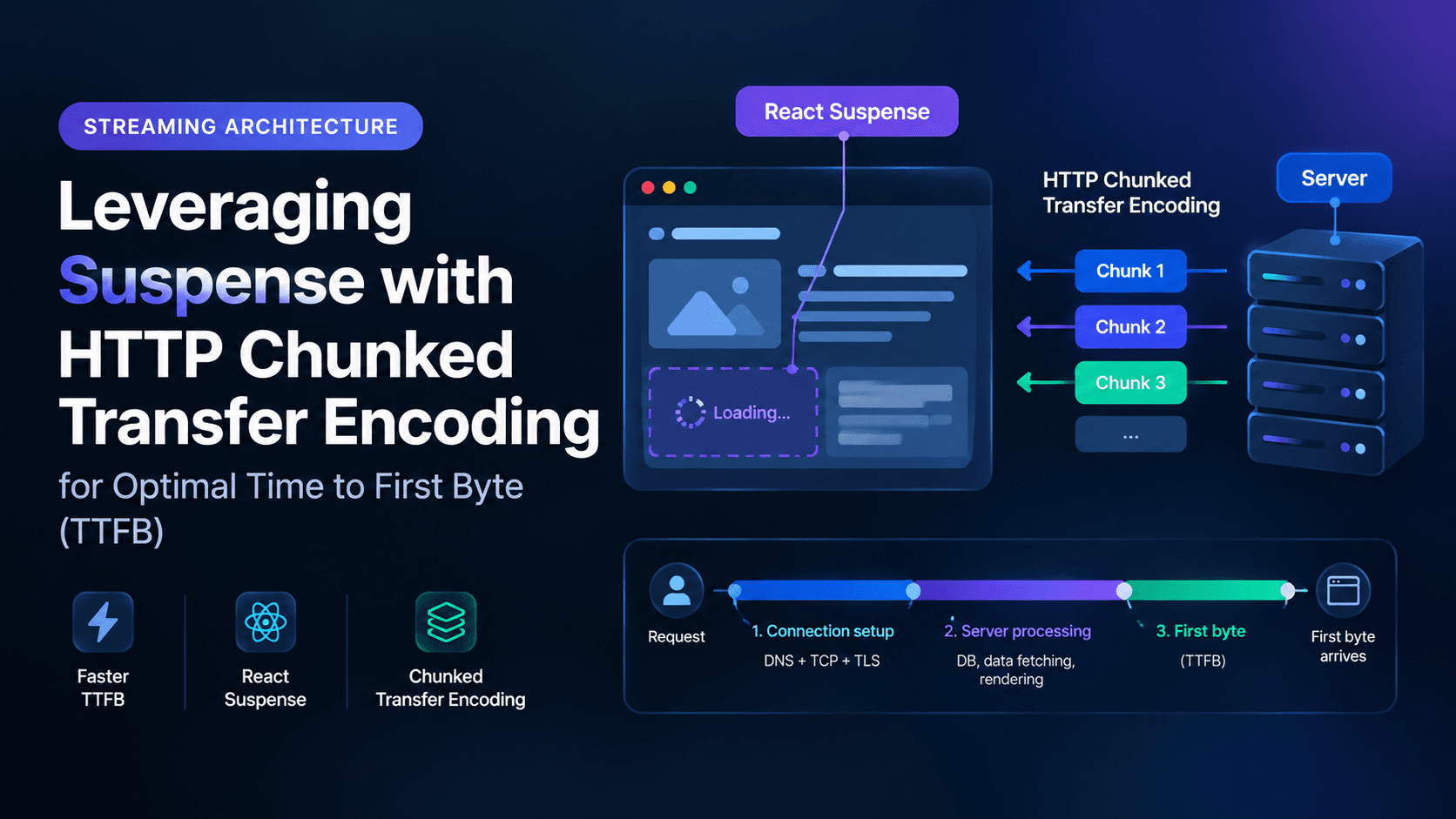
TTFB is the time between when a client sends an HTTP request and when it receives the first byte of the response. It is composed of three phases:
<html><head></head><body> 1e <header>Site Nav</header> 0
Connection setup — DNS lookup, TCP handshake, and TLS negotiation.
Server processing — the backend doing whatever work is needed to produce a response (database queries, data fetching, rendering).
Content transfer start — the moment the first byte of the response body reaches the network.
Google explicitly treats TTFB as a diagnostic metric that feeds into more user-centric measurements like Largest Contentful Paint (LCP), rather than as a Core Web Vital itself. A slow TTFB delays every downstream rendering milestone, which is why optimizing it has outsized effects on perceived performance.
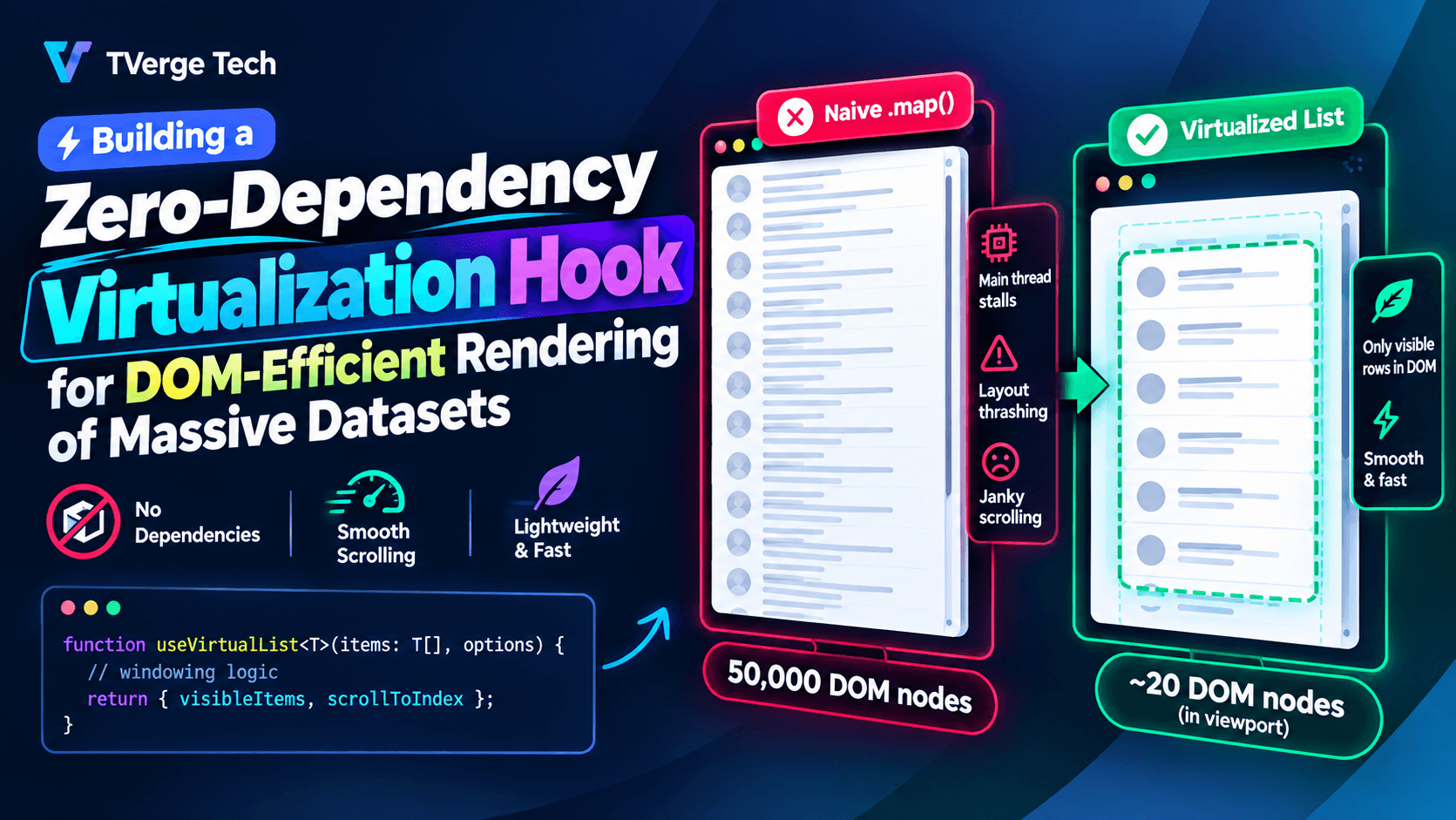
The critical insight for this article is phase two: server processing. In a traditional server-side rendering (SSR) model, the server does all the work — fetching data, rendering every component, generating the complete HTML document — before sending anything at all. If one slow API call blocks the render, the entire response is held hostage. Streaming architecture breaks this all-or-nothing dependency.
The Traditional (Blocking) SSR Problem
Consider a typical server-rendered page: a header, a fast-loading product list, and a slow-loading recommendations widget that depends on a third-party API.
In blocking SSR:
Request arrives
↓
Fetch header data (50ms)
↓
Fetch product list (120ms)
↓
Fetch recommendations (900ms) ← bottleneck
↓
Render full HTML
↓
Send response (TTFB ≈ 1070ms)
Even though the header and product list were ready in 170ms, the user waits over a second because the server won't send anything until the recommendations widget resolves. This is the core inefficiency streaming architecture solves.
HTTP Chunked Transfer Encoding: The Transport Foundation
Before Suspense can do anything useful, the underlying HTTP transport needs a mechanism to send a response in pieces rather than as one complete blob. That mechanism is chunked transfer encoding, defined in the HTTP/1.1 message syntax specification.
How Chunked Encoding Works
Normally, an HTTP response includes a Content-Length header so the client knows exactly how many bytes to expect. But if the server doesn't know the final size of the response upfront — because it's still generating content — it can't set that header accurately.
Chunked transfer encoding solves this by omitting Content-Length entirely and instead sending the response as a series of discrete chunks, each prefixed with its own size in hexadecimal, terminated by a zero-length chunk that signals the end of the message.
A simplified raw representation looks like this:
HTTP/1.1 200 OK
Transfer-Encoding: chunked
Content-Type: text/html
1a
Each hex number (1a, 1e, 0) indicates the byte length of the following chunk. The 0 chunk marks the end of the transmission. Critically, the browser can begin parsing and rendering HTML as each chunk arrives — it doesn't wait for the terminating chunk.
This is precisely what makes streaming SSR possible: the server can flush a chunk containing the <head> and initial shell HTML the moment it's ready, well before slower data-dependent content has resolved.
Why This Matters for TTFB
Chunked encoding doesn't reduce the total time to generate a full page. What it does is decouple "first byte sent" from "entire page computed." The server processing phase of TTFB shrinks dramatically because the server only needs to finish the first meaningful chunk — not the whole document — before it can start transmitting.
React Suspense: The Rendering-Layer Counterpart
Chunked transfer encoding gives you a pipe that can carry partial content. Suspense gives you a way to decide what counts as "ready" at each point in that pipe.
Suspense boundaries let you declare, at the component level, which parts of a UI can be sent immediately and which parts should be streamed in later once their data or code dependencies resolve.
When this tree is rendered via a streaming-capable server renderer, React:
Renders Header and ProductList synchronously.
Hits the Suspense boundary around Recommendations, which is still awaiting data.
Immediately emits the fallback (RecommendationsSkeleton) in the initial HTML chunk.
Continues rendering Recommendations in the background.
Once resolved, streams a second chunk containing the real content, plus a small inline script that swaps the fallback for the real markup in place — without a full page reload.
The React documentation describes this server streaming API directly: renderToPipeableStream (Node.js) and renderToReadableStream (Web Streams-compatible runtimes) are designed specifically to emit HTML progressively as Suspense boundaries resolve, rather than waiting for the entire tree.
The user perceives a page that started responding in 170ms instead of 1070ms — an 84% improvement in TTFB for the meaningful content, even though the slow API call still takes just as long in absolute terms.
How the Two Layers Connect
It's worth being explicit about the division of labor, since the two mechanisms operate at different layers of the stack:
Layer
Responsibility
Technology
Rendering
Decide what is ready to send and when
React Suspense boundaries
Transport
Decide how to send partial data over an open connection
HTTP chunked transfer encoding
Runtime
Bridge rendering output to the socket/stream
Node.js http module streams, Web Streams API
Suspense produces a sequence of renderable fragments. The server runtime pipes each fragment into the response stream as soon as it's available. The HTTP layer wraps each write in a chunk frame so the client can start consuming data mid-transmission. None of these three layers can achieve the TTFB benefit alone — remove any one, and you're back to a blocking, monolithic response.
Implementation Patterns
1. Shell-First Streaming (App Shell Pattern)
Render a static or near-static shell (navigation, layout, critical CSS) instantly, and wrap every data-dependent region in its own Suspense boundary. This is the pattern used by frameworks like Next.js's App Router, which builds its loading.js convention directly on top of React's streaming primitives.
2. Granular Boundaries for Independent Data Sources
Instead of one large Suspense boundary around an entire page, use multiple smaller boundaries around independent widgets. This allows fast content to stream out even faster, since it isn't grouped with slower siblings.
Each boundary resolves and streams independently, in whatever order its data becomes available — not necessarily the order they appear in the tree.
3. Prioritizing Above-the-Fold Content
Since chunk order affects what the browser paints first, place your most performance-sensitive (and usually most SEO-relevant) content in boundaries that resolve earliest. Deprioritize below-the-fold or non-critical widgets by wrapping them in their own later-resolving boundaries.
4. Server Configuration Considerations
Chunked transfer encoding must not be interfered with by intermediary layers. Common pitfalls include:
Reverse proxies buffering the full response before forwarding it (some default Nginx configurations do this — proxy_buffering needs to be explicitly tuned).
Compression middleware that waits for the full stream before gzipping, which negates streaming's benefit. Streaming-aware compression must compress chunk-by-chunk.
CDNs or edge functions that cache the entire response before serving it, effectively converting a streamed response back into a blocking one for cached hits.
Trade-offs and When Not to Stream
Streaming architecture is not universally beneficial. Consider the following before adopting it:
SEO crawling behavior: Search engine crawlers generally do render JavaScript and handle streamed HTML fine, but it's worth verifying that critical content isn't trapped in a Suspense boundary that never resolves for bots with tighter timeouts.
Very fast APIs: If all your data sources resolve in under ~50ms, the added complexity of Suspense boundaries and streaming infrastructure may not yield a perceptible benefit.
Error handling complexity: A component that throws inside a Suspense boundary after the shell has already streamed to the client requires careful error boundary placement, since you can no longer swap the entire response for an error page.
HTTP/1.0 clients or misconfigured proxies: Chunked transfer encoding is an HTTP/1.1 feature; environments that don't support it will fail to interpret streamed responses correctly.
Measuring the Impact
To validate that a streaming migration actually improved TTFB, measure:
Server-Timing headers to break down time spent per rendering phase.
Real User Monitoring (RUM) TTFB values before and after rollout, segmented by connection type and geography.
Chunk arrival timing via browser DevTools' Network panel, inspecting the timeline of individual data frames rather than just the aggregate load time.
A meaningful before/after comparison should isolate the server processing phase specifically, since streaming does nothing to improve DNS, TCP, or TLS setup time.
Conclusion
Streaming architecture reframes TTFB from a single monolithic bottleneck into a series of independently resolvable fragments. HTTP chunked transfer encoding provides the transport mechanism to send partial responses over a still-open connection, while React Suspense provides the rendering-layer logic to decide what belongs in each fragment and when it's ready. Neither technology alone solves the blocking-SSR problem — it's the combination, correctly wired through your server runtime and infrastructure, that turns a multi-second wait into a shell that appears almost instantly, with the rest of the page filling in as data arrives.
For further technical depth, the official specifications and framework documentation referenced throughout this article are the most reliable source of truth as these APIs continue to evolve.