Six weeks ago, SpaceX stock closed at $154.60 after its worst single session since going public. Today — August 5 — it's trading around $125. The panic that made headlines in late June wasn't the bottom. It was the midpoint.
The headline event
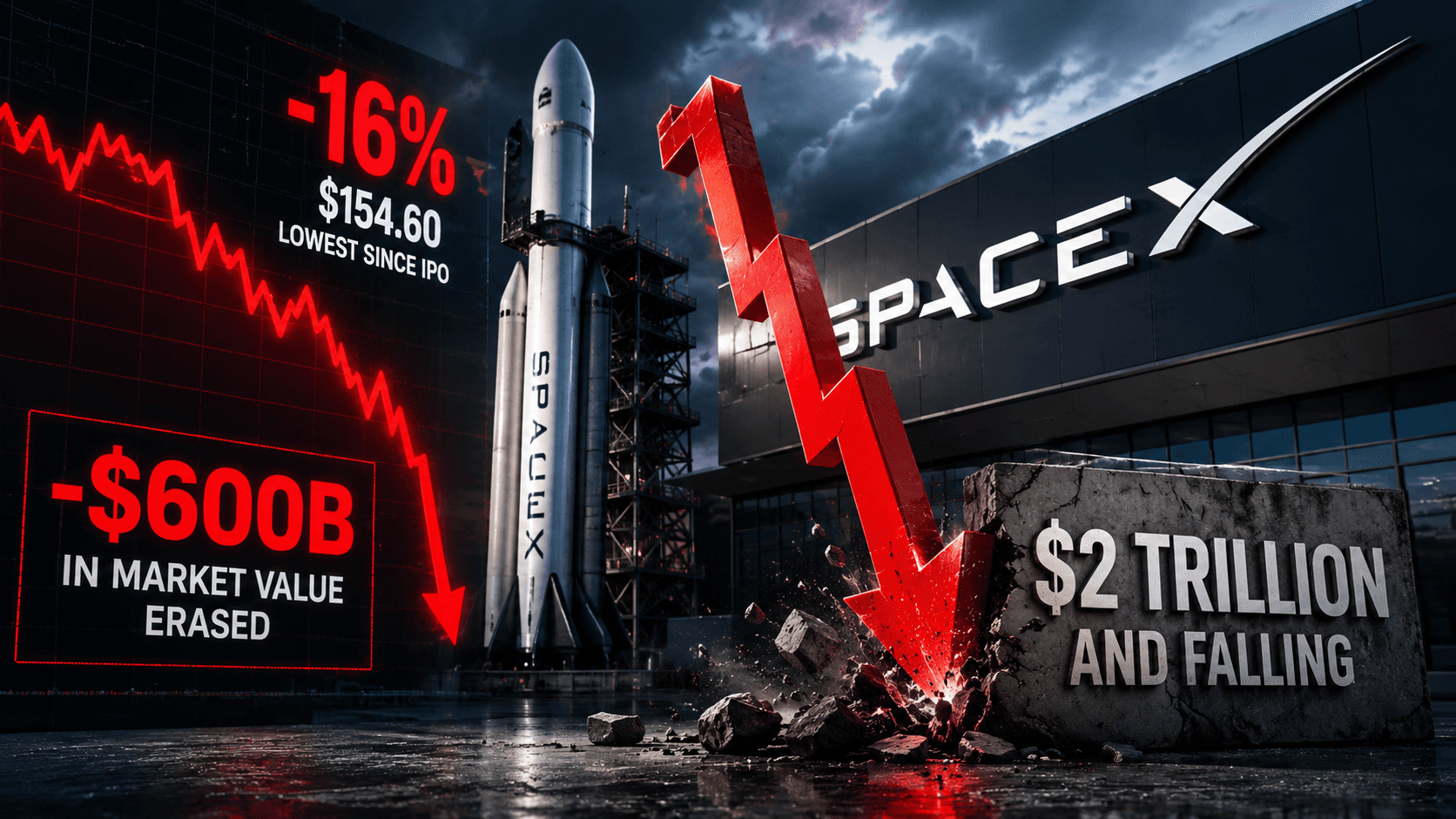
On June 22, 2026, SPCX fell 16% in a single session to close at $154.60, its lowest level since the stock's Nasdaq debut. That drop capped a three-day slide of 23%, erasing more than $600 billion in market value and pulling the company's valuation down to just above $2 trillion. The trigger wasn't a launch failure or a Starlink outage — it was a financing announcement. SpaceX disclosed it was selling investment-grade bonds for the first time, seeking at least $20 billion, as part of a larger borrowing campaign to fund its AI buildout across xAI integration and data-center capacity.
That's the event the headlines described. But it wasn't the first time SpaceX had erased $600 billion in three days — and understanding why requires backing up to the IPO itself.
A stock built for whiplash
SpaceX priced its IPO at $135 per share on June 11, raising $75 billion — the largest public offering in history — at a valuation near $1.75 trillion. Shares opened at $150 and closed day one at roughly $161, up about 19%. Demand kept building: by June 16, the stock had climbed as high as $225.64, pushing SpaceX's paper valuation above Amazon's for a brief window and lifting Elon Musk toward trillionaire status on paper.
Then came the first reversal. SpaceX announced a $60 billion all-stock acquisition of Cursor, the AI coding startup, representing roughly 3.4% dilution. Investors didn't love the math: by June 18, the stock had fallen 20% from its Tuesday peak, wiping out about $620 billion in value in three sessions and dropping SpaceX out of the world's top-five most valuable companies.
Two separate three-day stretches — one triggered by an acquisition, one by a bond sale — each erased roughly $600 billion in SpaceX's market value within the space of about ten days.
That repetition is the part most single-day coverage missed. This wasn't one shock; it was a stock still finding its footing, twice.
Timeline at a glance
| Date | Event | Close / move |
|---|---|---|
| Jun 11 | IPO priced | $135/share, $75B raised |
| Jun 12 | Nasdaq debut | Closed ~$161 (+19% day one) |
| Jun 16 | Post-IPO peak | $225.64 intraday |
| Jun 18 | Cursor deal fallout | –20% from peak, ~$620B erased |
| Jun 22 | Bond-sale selloff, day 3 | $154.60 (–16% that day, –23% over 3 days), ~$600B erased |
| Aug 5 (today) | Current | ~$125, 52-week range $104.83–$225.64 |
What the market was actually pricing
The bond announcement mattered less as new information about SpaceX's ambitions — which were already public — and more as a signal about how much cash those ambitions require. Framing the AI buildout as something that needs a $20 billion debt raise shifted the narrative from unlimited demand to capital intensity, and capital intensity is a valuation question investors know how to model, unlike hype.
Sentiment data backed that shift. Retail investors kept buying through the selloff, per Vanda Research figures cited in coverage, though at a slower pace than the prior week. That's not capitulation — it's fatigue. As trader Michael O'Rourke put it during the slide, describing the buyer pool as largely exhausted: "Anyone in the world who wanted to buy this has bought it already."
Sell-side research reflected the same recalibration rather than panic. KeyBanc Capital Markets initiated coverage with what amounted to its first hold-equivalent rating on the stock, with analyst Michael Leshock writing that SpaceX has real disruptive growth avenues but that much of that value already appears reflected in the price, calling the risk/reward roughly balanced.
Why the drop didn't erase the thesis
Even at $154.60, SpaceX was still trading above its $135 IPO price — a detail that got lost in "erased $600 billion" headlines, which describe the size of the move, not whether the stock was underwater. A 23% three-day decline sounds catastrophic against a post-IPO peak; it reads differently against an offer price investors had already validated with $75 billion in demand five business days earlier.
The bull case that survived the selloff was narrower, not gone: SpaceX's core position in space launch wasn't in question, and the AI narrative — its Reflection AI deal, xAI integration, and data-infrastructure investments — still had backers. What analysts wanted next wasn't reassurance, it was evidence: proof that compute spend converts into revenue large enough to justify a multi-trillion-dollar valuation built substantially on a story still being written.
What the six weeks since show
The stock hasn't recovered — it's kept drifting toward and now through its IPO price, sitting roughly 7% below the $135 offer as of today, with a 52-week low of $104.83 already logged. That's a meaningfully different picture than either single "$600 billion erased" headline captured on its own. Read together, the two selloffs look less like a correction and more like a market still pricing a company that skipped the normal private-to-public price-discovery process — testing, in real time, what SpaceX is actually worth without the scarcity that made pre-IPO shares trade at $832 on secondary markets earlier in the year.
Whether $125 is closer to a floor than $154.60 was is the question the next headline will answer. It isn't one this one can.