88.8% and 91.9%.
Those two numbers are both GPT-5.6 Sol's score on Terminal-Bench 2.1, OpenAI's command-line agentic coding benchmark. The gap between them isn't a training run or a model update — it's a setting. The higher figure comes from "Ultra," a mode that coordinates multiple subagents in parallel on the same task, and independent coverage of the preview period attributes that 3.1-point gain to compounding performance from parallel execution on complex, open-ended tasks — the kind Terminal-Bench 2.1 is built to measure. Ultra burns several times the tokens of a standard call to get there. Whether that trade is worth it depends entirely on what you're building, not on which number looks better in a launch post — and that dependency is the real story behind GPT-5.6.
A three-model bet on "it depends"
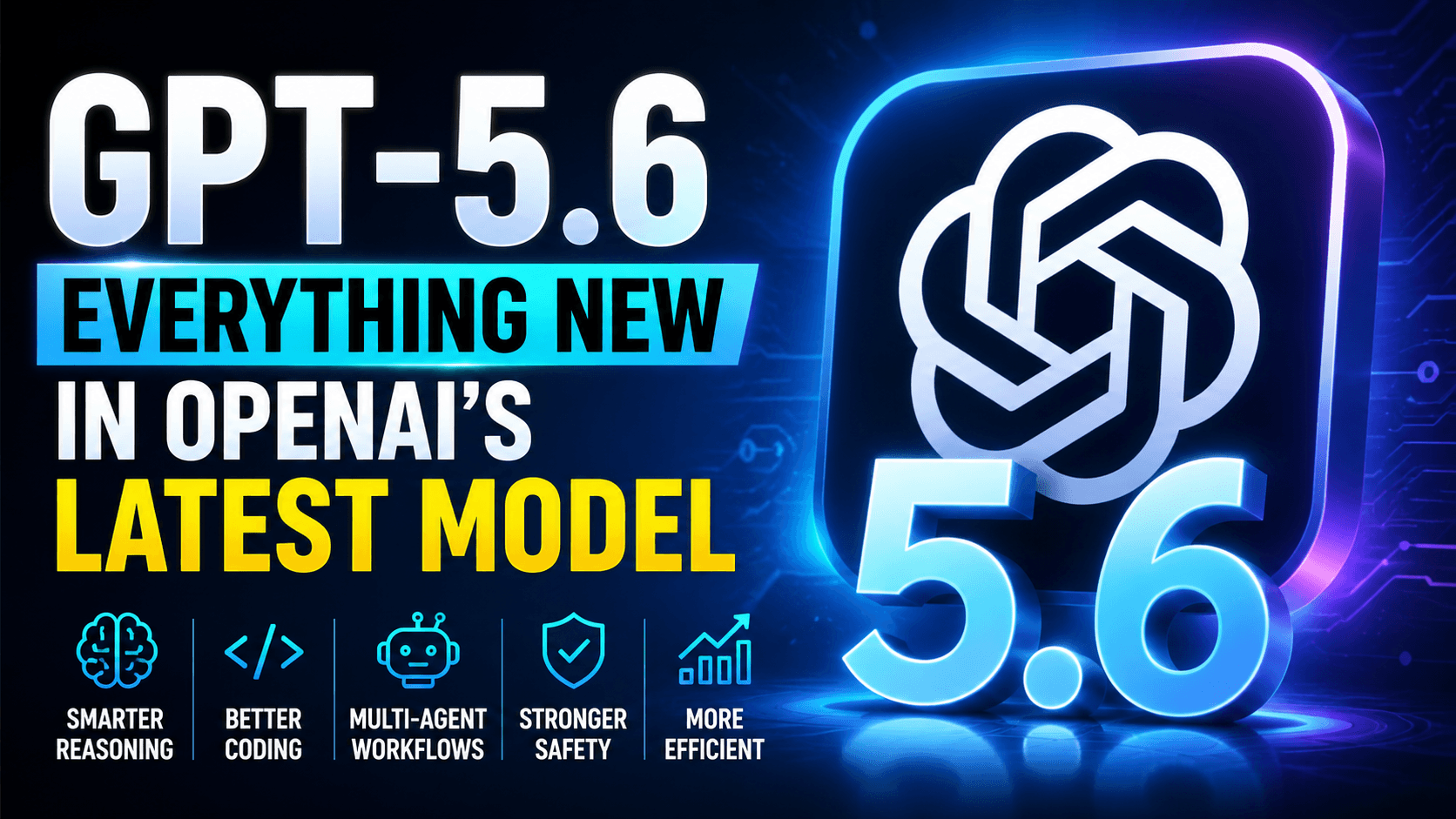
OpenAI didn't ship one GPT-5.6. It shipped three — Luna, Terra, and Sol, ranked in that order from cheapest to most capable — plus an Ultra compute tier sitting on top of Sol for the hardest jobs. Per OpenAI, the family was designed to expand user capabilities across enterprise work, coding, scientific research, and cybersecurity.
| Tier | Positioning | Reported edge |
|---|---|---|
| Sol | Flagship, "best coding model yet" | Sets a new state of the art on Terminal-Bench 2.1 |
| Terra | Balanced, lower-cost | Performs just above Claude Fable 5 at ~1/3 the time and ~half the output tokens |
| Luna | Fastest, cheapest | Outperforms Claude Opus 4.8 at ~1/4 the estimated cost of Sol |
| Sol Ultra | Multi-agent, highest compute | 91.9% on Terminal-Bench 2.1 vs. Sol's 88.8% |
Splitting a release into a graded family is itself a workflow argument. A single flagship model invites a single benchmark chart. Three tiers plus a compute dial invite a cost-per-task conversation instead — which is the framing OpenAI leaned into throughout the launch.
The efficiency claim is the load-bearing one
Every other claim in the launch rests on token efficiency, so it's worth isolating.
The catch: because each subagent consumes tokens independently, a single Ultra call can cost several times a standard Sol call. Efficiency and Ultra mode pull in opposite directions.
At the standard Sol tier, the case is more modest than the marketing implies. Third-party benchmarking firm Artificial Analysis measured Sol at maximum reasoning effort using ~15,000 tokens per Intelligence Index task, against ~16,000 for GPT-5.5 — real, but incremental, not the headline figure. The bigger number is specific to coding: OpenAI reports roughly 54% improved token efficiency on agentic coding tasks compared to prior models. A developer-focused analysis frames the same pattern as more concise, precise generation rather than compression — walking through a scenario where a task previously costing ~2,000 output tokens lands closer to ~920 with Sol, attributing the drop to completeness retained at lower verbosity, not truncation.
That distinction — fewer tokens because the model reasons more directly, versus fewer tokens because it simply says less — is exactly what a leaderboard score can't resolve. It only becomes visible when someone runs the same workflow twice and reads the output.
Where the benchmark framing breaks down
Independent reviewers have been blunt about the limits of headline numbers here.
- Trust gap: One review from the preview period put it plainly — whether Sol's benchmark numbers can be trusted is a separate question from whether they're accurate, landing somewhere between "use with caution" and a warning against building procurement decisions on them alone.
- Methodology gap: A developer writeup on Sol notes that differences in evaluation harness configuration and task-set composition make cross-vendor comparisons unreliable without methodological alignment between labs.
- Coverage gap: The same writeup points out that indices like the Coding Agent Index don't capture IDE integration quality, context-window utilization, or failure-recovery behavior in production — and don't reflect how a model handles ambiguous specs or noisy, adversarial real repositories.
- Latency gap: In head-to-head testing against a rival model, Sol's time-to-first-token ran ~800ms–1.5s, against ~400–800ms for the competitor — a gap that compounds across the many sequential tool calls typical of agentic workflows.
A model can lead on accuracy and still lose on the metric that determines whether an agent pipeline feels responsive to the person waiting on it.
What OpenAI is actually optimizing for
The company's own framing keeps returning to work, not test scores. On Agents' Last Exam — an evaluation of long-running professional workflows spanning 55 fields — OpenAI reports Sol set a new high score, ahead of Claude Fable 5. The knowledge-work pitch is similarly workflow-shaped: OpenAI describes GPT-5.6 as designed to take messy context from documents and everyday tools like Slack, Notion, Microsoft 365, and Google Drive and convert it into shareable, expert-level artifacts.
Two more results reinforce that the target is sustained task execution rather than single-shot accuracy: OpenAI reports new results on BrowseComp at 92.2% and OSWorld 2.0 at 62.6%, with Sol surpassing Opus 4.8 on OSWorld while using 85% fewer output tokens. These are multi-step, tool-using evaluations by design — closer to "operate a computer for ten minutes" than "answer one question correctly."
The part that doesn't fit the efficiency narrative
Not every axis moved to make room for workflows. Safety classification went up, not down.
OpenAI's system card designates all three models — Sol, Terra, and Luna — as High in Biological and Chemical risk and High in Cybersecurity under its Preparedness Framework: reportedly the first time smaller models in a family received the same tracked-risk designation as the flagship.
On the offensive-security question specifically, OpenAI's own testing found a boundary rather than a breakthrough: Sol is described as better at helping people find and fix vulnerabilities than at reliably carrying out end-to-end attacks. In evaluations involving Chromium and Firefox, it identified bugs and exploitation primitives without autonomously producing a functional full-chain exploit under the conditions tested.
That's a meaningful caveat for any organization treating "workflow-optimized" as synonymous with "safer by default." A model built to sustain long, tool-using tasks is, by construction, a model built to sustain long, tool-using offensive tasks too — which is presumably why the safeguards scaled with capability rather than staying flat across the family.
Reading the pricing as a design document
Pricing tends to reveal intent better than marketing copy does. Sol is listed at $5.00 input / $30.00 output per million tokens — well above Luna and Terra — and OpenAI frames the whole family's advantage in cost-per-task terms rather than raw capability: Sol is pitched as costing about one-third less than Claude Fable 5 while using less than half the output tokens and taking less than half the time, with Terra and Luna extending that pattern at roughly one-quarter Sol's estimated cost. A leaderboard position is static. A cost-per-completed-task figure moves with how a team actually uses the model — which is the number that survives contact with a production budget.
The honest summary
GPT-5.6's real pitch isn't "smarter than the last model." It's "cheaper to run the same workflow twice, and built to keep running it for longer without falling over." The Terminal-Bench gap between 88.8 and 91.9 is a fine illustration of why that framing matters: it isn't a measure of intelligence, it's a receipt for compute spent on parallelism. Any team evaluating GPT-5.6 against a rival on benchmark score alone is comparing receipts for two different shopping trips — and the number on the receipt was never the point.