We use cookies for analytics and advertising. Ads are disabled until you accept advertising cookies. Read our Cookie Policy and Privacy Policy.
How Agentic Coding Changed Software Development in 2026 | TVerge Tech
How Agentic Coding Changed Software Development in 2026
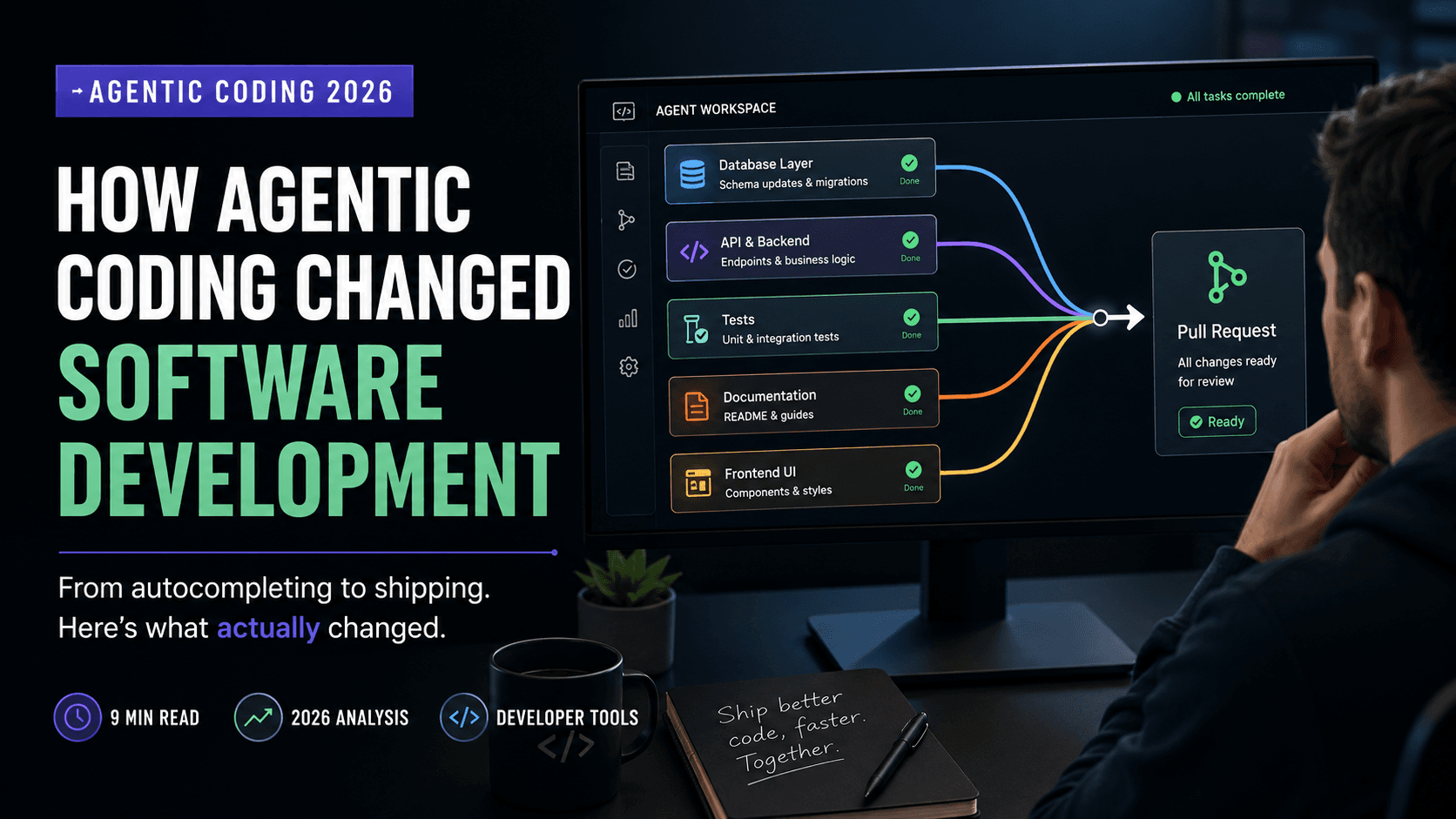
Agentic coding didn't just make developers faster in 2026 — it moved the bottleneck from writing code to reviewing it. Here's the structural shift, by the numbers.
How Agentic Coding Changed Software Development in 2026
The pitch for agentic coding was always about speed: an AI that doesn't just autocomplete a line but plans a feature, writes it across a dozen files, runs the tests, and opens a pull request. That pitch turned out to be true. What it left out is what happened next. Pull requests didn't get merged faster in 2026 — in aggregate, they got merged slower, because the constraint in software delivery didn't disappear when code generation got cheap. It moved. Understanding where it moved, and why, explains more about this year than any adoption statistic does.
From Reactive Autocomplete to Closed-Loop Agents
The distinction that matters isn't "AI helps you code" versus "AI doesn't." Copilot-style tools have been reactive since 2021 — they respond to a cursor position or a prompt, and a human evaluates each suggestion before it lands. What changed in 2026 is the shift to systems that operate in a closed loop: interpret a task, plan an approach, write code across multiple files, execute the test suite, diagnose failures from the output, and iterate — without a human in the loop between each step. Claude Code, OpenAI's Codex, Google's Jules, and Cognition's Devin are the tools most associated with this pattern, and by mid-2026 they'd converged on largely the same closed-loop agent architecture: a planning phase, tool-calling against the filesystem and a shell, a test-execution loop, and an escalation path back to a human when the task is ambiguous or the stakes are high enough to warrant it.
The scale of that loop is the tell. Average AI coding session length grew from roughly four minutes in early 2025 to over twenty minutes in early 2026 — not because responses got slower, but because agents started handling tasks that used to require several separate human-initiated prompts strung together. One widely cited case: engineers at Rakuten set an agent loose on a single hard task inside vLLM, a 12.5-million-line open-source inference library, and it worked autonomously for seven hours before finishing with 99.9% numerical accuracy. That's not a faster autocomplete. It's a different category of tool, and the volume shows it — GitHub reported developers merging more than 40 million pull requests a month in 2026, with commit volume up 25% year-over-year.
The Benchmark Numbers Everyone Cites, and What They're Not Measuring
SWE-bench Verified became the industry's reference point for agent capability because it tests something closer to real work than earlier benchmarks: given a real GitHub issue and the full repository, can the agent produce a patch that makes the existing test suite pass. The trajectory is genuinely dramatic. GPT-4o solved roughly a third of tasks at the benchmark's August 2024 launch. By mid-2025, leading agentic systems were clearing 70%. By May 2026, the top of the leaderboard sat around 93.9%, with several frontier models in the mid-to-high 80s behind it.
Read as a single number, that trajectory implies coding is nearly solved. It isn't — and the benchmark's own maintainers are the ones saying so most clearly, as detailed on the official SWE-bench Verified methodology page. OpenAI has publicly cautioned that SWE-bench Verified is increasingly exposed to data contamination and now recommends its harder successor, SWE-bench Pro, as the more reliable measure. Independent analysis of the leaderboard found a more specific problem: roughly a fifth of "solved" cases on SWE-bench Verified were patches that passed the test suite but were semantically wrong — the kind of fix that looks correct to an automated check and wrong to an engineer who actually reads it. That gap between "passes tests" and "is actually right" is the same gap that's now defining the next section of this piece, because it's exactly what human reviewers are stuck reconstructing by hand.
[CHART: line — SWE-bench Verified leaderboard top score by quarter, August 2024 through May 2026]
Where the Bottleneck Actually Moved: Code Review
This is the structural consequence that the "AI writes code now" framing skips entirely. Code generation getting cheap didn't make software delivery faster in aggregate — it moved the constraint downstream, to the point where a human has to decide whether to trust output they didn't write. The numbers on this are consistent across multiple independent datasets in 2026. LinearB's benchmarking work found agentic pull requests sit in a reviewer's queue 5.3 times longer before anyone picks them up, and wait 2.47 times longer overall than requests without AI involvement. Separately, telemetry across roughly 22,000 developers found median code review time up 441.5% even as raw task throughput rose 33.7% — meaning the extra output isn't reaching production meaningfully faster, because it's queuing at review instead of at implementation.
The mechanism behind that number is worth understanding rather than just citing. AI-generated code reads as more plausible on a casual pass than it actually is — a diff that compiles, follows local conventions, and passes the existing test suite can still misunderstand the underlying intent of the change, and a reviewer has to reconstruct that intent from the ticket and the diff alone, since there's no human memory of writing it to fall back on. Trust in AI-generated output fell from roughly 40% to 29% among developers over the same period, which sounds like it should slow adoption — instead it slowed review, because developers kept shipping AI-authored code while trusting it less, which means every diff gets read more skeptically than the equivalent human-written one used to be. Specific failure patterns compound this: agents calling library methods that exist in training data but not in the pinned dependency version, agents writing a new helper function instead of finding the equivalent one that already exists in the codebase, and — documented in a 2026 study of over 500,000 hallucinated package references — agents inventing dependencies that don't exist at all, which is now a live supply-chain attack vector rather than a theoretical one.
Engineering teams that are ahead on this problem in 2026 didn't try to review every diff at the same depth. They moved to a form of code review triage: a configuration change gets a linter and a glance, a change touching a payments path or an auth boundary gets the full stack — type checks, an automated security pass, and a human owner who actually knows that system. One analysis of this pattern found that gating only the riskiest 20% of pull requests captures roughly 69% of the total review effort that matters, which means the other 80% of volume can move through a fast path without meaningfully increasing risk. That's a direct answer to the throughput-versus-safety tension the review data exposes — not by reviewing less, but by spending review capacity where a wrong answer is actually expensive.
The Developer's Role Shifted From Typing to Specifying and Verifying
Forrester's 2026 research on this shift traces a clear arc: through 2023 and 2024, AI coding tools mostly handled implementation and unit-test generation. By 2025, that expanded into adjacent tasks like documentation and test scaffolding. The 2026 inflection is different in kind — agents now operate across planning, implementation, testing, and delivery as a connected sequence, and a team can delegate an intent like "add rate limiting to the API gateway" rather than a specific implementation plan. The agent decomposes the work, writes the code across the affected modules, runs the tests, and opens the pull request. A human stays accountable for the outcome, but the execution is no longer theirs by default.
That shift comes with a caveat that's easy to miss in the productivity headlines: partial adoption doesn't produce partial gains — it produces almost none. Analysts tracking this found that raw coding throughput can improve 30 to 40% under agentic tools, but if planning, testing, and release remain manual, overall team productivity often rises by less than 10%, because the bottleneck simply relocates to whichever stage is still bound by human throughput. This is the practical reason "just add an AI coding tool" underdelivers for teams that don't also redesign the surrounding process — the same logic that governs any pipeline with one automated stage and several manual ones.
Where the Major Agentic Tools Actually Diverge
The tooling landscape converged on similar underlying loop architecture in 2026, but the products differentiate on where that loop runs and how a developer interacts with it.
Tool
Primary Environment
Execution Model
Best-Fit Workflow
Claude Code
Terminal-native
Synchronous, interactive
Deep work inside an existing codebase, multi-file refactors
OpenAI Codex
Cloud sandbox
Asynchronous, multi-hour
Long-running tasks handed off and checked on later
Cursor
In-editor IDE
Synchronous, in-flow
Continuous pair-programming across a full editor session
Devin (Cognition)
Cloud-hosted agent
Autonomous, ticket-driven
End-to-end feature delivery from a task description
The practical difference is where a developer's attention sits. Terminal- and editor-native tools keep a human in the loop turn by turn, which suits work where intent is hard to fully specify up front. Cloud-sandboxed and autonomous tools trade that immediacy for throughput — you write the specification once and check back on a result, which only pays off when the specification itself was precise enough that the seven-hour version of the Rakuten example is the outcome rather than a seven-hour detour.
The Labor Market Absorbed This Unevenly
The clearest, most contested consequence of agentic coding in 2026 is what it did to entry-level hiring, and the honest answer is that it split the industry rather than settling it. Junior developer employment has declined for a reported 33 consecutive months, and entry-level postings at large tech employers fell sharply through the first half of 2026. The reasoning companies give is straightforward: a senior engineer equipped with an agentic tool can now cover work that used to require several juniors implementing under supervision, so the traditional pipeline of hiring juniors to do routine implementation work has less to hire for.
Not every company drew that conclusion, though, and the split is instructive. Some enterprise employers increased junior hiring in 2026 rather than cutting it — but restructured the role itself, shifting juniors away from writing routine implementation code and toward reviewing and debugging AI-generated output, on the reasoning that an engineer who can tell when an agent's plausible-looking code is wrong is more valuable than one who can write correct code slowly by hand. The entry-level technical interview reflects that shift directly: candidates increasingly get handed an AI-generated codebase and asked to find what's wrong with it, rather than asked to write an algorithm from scratch. The open question — and it is genuinely open, not resolved — is whether the companies still investing in junior hiring are building the senior pipeline the rest of the industry will need in five years, or whether the ones that cut it were simply first to recognize a structural change everyone else will follow.
Key Takeaways
Agentic coding's defining shift in 2026 is architectural, not incremental: tools moved from reactive, single-prompt assistance to closed loops that plan, execute, test, and iterate without a human between each step.
SWE-bench Verified scores climbed from roughly 33% to the low-to-mid 90s in under two years, but the benchmark's own maintainers now flag contamination risk, and independent analysis found a meaningful share of "passing" solutions are semantically wrong.
The real 2026 bottleneck isn't code generation — it's review. Agentic pull requests wait multiple times longer for a reviewer and take substantially longer to clear, because plausible-looking AI output requires more scrutiny, not less.
Risk-tiered review — full scrutiny on high-stakes changes, a fast path for everything else — is the practice separating teams that are actually shipping faster from teams whose throughput gains are stuck in a review queue.
Productivity gains don't scale with adoption unless the whole pipeline changes: coding-only automation can lift implementation speed 30–40% while leaving overall team output nearly flat, because the bottleneck relocates rather than disappears.
The labor market effect on junior developers is real but unresolved — some employers are cutting entry-level hiring, others are restructuring it around AI-output review, and which strategy holds up is still an open question.
What This Means for Engineering Teams Going Forward
The tools got better at writing code in 2026. That much is measurable and not seriously in dispute. The part that's easy to miss from the outside is that better code generation didn't translate directly into better software delivery, because delivery was never bottlenecked purely on typing speed — it was bottlenecked on judgment: knowing what to build, verifying that what got built is actually right, and deciding how much scrutiny a given change deserves. Agentic tools automated the first of those and, so far, made the other two harder rather than easier. The engineering organizations pulling ahead this year aren't the ones with the fastest agent — they're the ones that redesigned review, specification, and risk triage around the assumption that code now arrives faster than anyone can casually trust it.
3Demystifying the Rust Borrow Checker: Fix Lifetime Errors Fast