We use cookies for analytics and advertising. Ads are disabled until you accept advertising cookies. Read our Cookie Policy and Privacy Policy.
GitHub Copilot Faces Tougher Competition in 2026 | TVerge Tech
GitHub Copilot Faces Tougher Competition in 2026
A chronological look at how Cursor and Claude Code ate into GitHub Copilot's dominance in 2026 — the agent mode rollout, the billing shift, and the survey data behind the shift.
A year ago, "Copilot" was close to a generic term for AI coding assistance the way "Google it" is for search. In 2026, that's no longer true, and the shift didn't happen through one dramatic event — it happened through a sequence of product launches, a billing change, and a run of survey data that, read in order, tells a much more specific story than "Copilot is losing." Here's that sequence.
Where Copilot Stood Entering 2026
By July 2025, GitHub Copilot had reached 20 million cumulative users, a 5-million-user jump in just three months, and it was integrated across VS Code, JetBrains, Visual Studio, Neovim, Eclipse, and Xcode. Agent Mode — the feature that lets Copilot plan a multi-file change, edit code, run terminal commands, and iterate on errors without a human approving each step — had gone generally available in VS Code that April and expanded to the other major IDEs by July. On paper, Copilot's footprint was the widest in the category: reporting at the time put its overall market share around 42%, with a presence across roughly 90% of Fortune 100 companies.
The cracks were already visible in the numbers Microsoft doesn't put in a press release, though. Among paying Microsoft 365 Copilot subscribers specifically, GitHub Copilot's share of preference fell from 18.8% in July 2025 to 11.5% by January 2026 — a narrower metric than overall market share, but an early signal that the newer, more specialized tools were pulling users away from the incumbent's home turf.
GitHub's clearest countermove landed in March 2026, when it shipped Agent Mode to full parity in JetBrains IDEs — custom agents, sub-agents, and a "plan agent" that breaks a task into steps before executing it, all reaching general availability at once rather than trickling out over months. The pace of that rollout is itself informative: it compressed into a few weeks work that had taken roughly a year to reach VS Code. That's the behavior of a team responding to a competitor's roadmap, not one setting its own pace.
The underlying mechanism matters here, because it's the same one every entrant in this category is racing to get right: an agent doesn't just autocomplete a line, it indexes the repository, forms a plan, edits across multiple files, runs validation, and opens a pull request — the difference between reactive ghost-text and something closer to a junior engineer working from a ticket. GitHub layered a second version of this on top in the following weeks: a "coding agent" that works asynchronously against an assigned GitHub issue, pushing a draft PR while the developer is away entirely, plus an agentic code-review feature that comments on pull requests with full repository context. By May 13, 2026, a CLI-based agent for JetBrains reached public preview alongside a unified sessions view — GitHub layering agent surfaces faster than most teams could evaluate them.
April 2026: The Survey Data Starts Telling a Different Story Than the Feature Announcements
Shipping fast didn't translate into winning developer sentiment. An April 2026 JetBrains Developer Ecosystem survey found 46% of senior engineers named Claude Code their most-loved coding tool, against 9% for GitHub Copilot — a roughly five-to-one gap among the most experienced segment of the developer population. The same period saw Claude Code's at-work usage climb sixfold, from about 3% in mid-2025 to 18% by April 2026, and one survey found 75% of startups reporting it as their primary AI coding tool, against 56% for Copilot inside large (10,000-plus employee) enterprises — a split that maps cleanly onto company size: startups optimizing for raw task-completion speed, large enterprises optimizing for the tool already wired into their existing GitHub governance and licensing.
Cursor's trajectory over the same stretch was different in kind: it wasn't winning a sentiment survey so much as converting usage into revenue. It reached $2 billion in annualized recurring revenue by February 2026 with a paying user base reported above 1 million, and industry reporting pointed to a $60 billion valuation shortly after — extraordinary for a company that didn't exist as a mainstream product three years earlier.
April 20 and June 1, 2026: GitHub Changes How Copilot Is Priced
On April 20, 2026, GitHub paused new sign-ups to the Pro, Pro+, and Student plans, a quiet precursor to a larger change: on June 1, 2026, Copilot moved its chat, agent mode, code review, and cloud agent usage onto usage-based billing, priced in AI Credits at $0.01 each, replacing the older flat-rate Premium Request Units system. Code completions and Next Edit Suggestions stayed unlimited and outside the credit system — GitHub kept the original, free-feeling core of the product untouched while making the newer agentic features cost proportional to how much a developer actually uses them. Model choice now has a direct budget impact: heavier frontier models carry a higher credit multiplier per request than lighter ones, according to GitHub's own documentation.
That change removed something that had quietly been part of Copilot's appeal since 2021: a predictable flat monthly price, regardless of how hard a developer leaned on it. Multiple surveys conducted after the shift point to it as a specific driver of the erosion in Copilot's numbers — not the only cause, but a concrete, dateable one sitting right next to the sentiment decline, rather than a vague "competition intensified" explanation.
Mid-2026: What the Broadest Surveys Actually Show
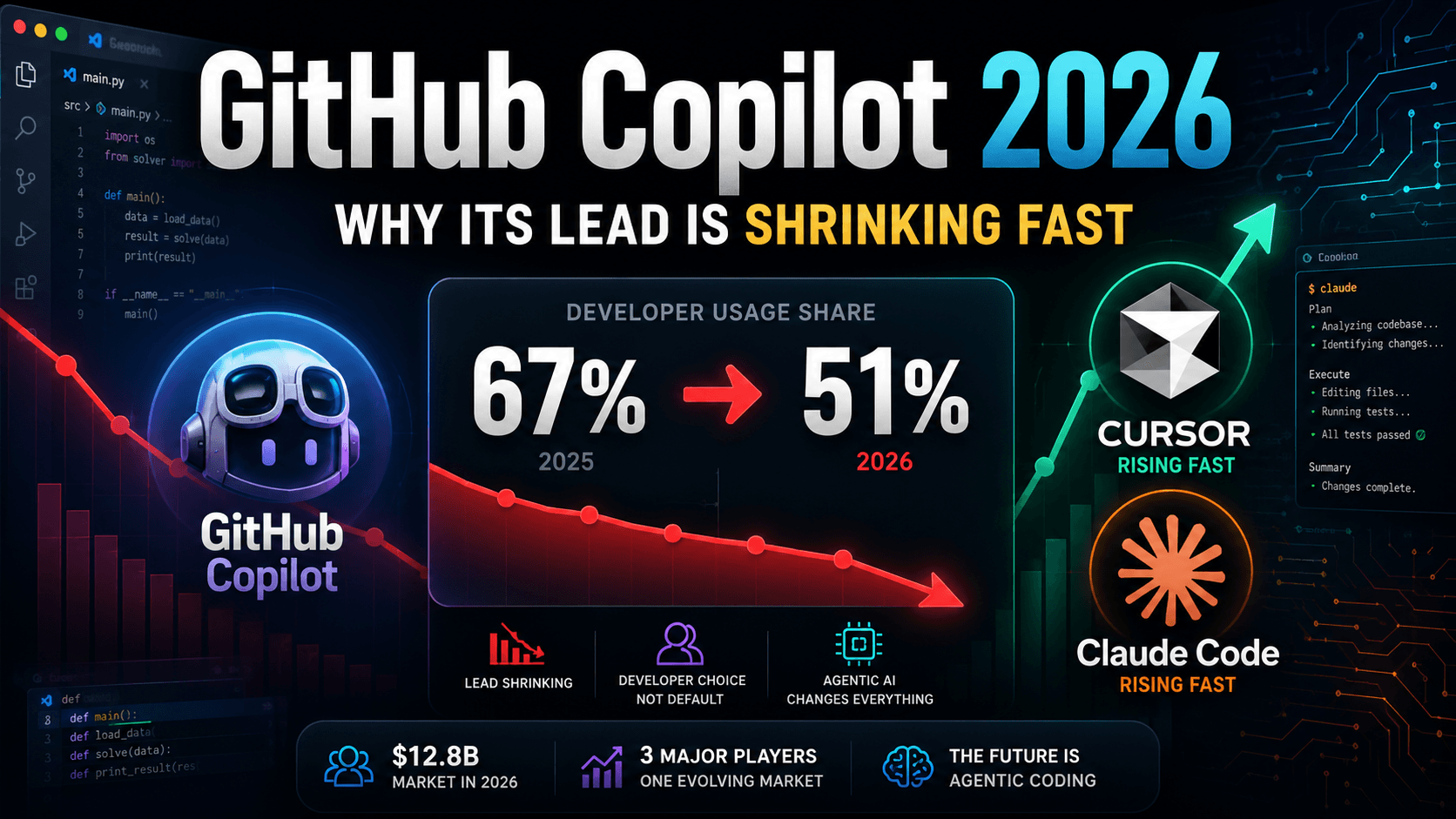
By June 2026, the Stack Overflow Developer Survey recorded Copilot's share among professional developers falling from 67% to 51% year over year. It's worth being precise about what that specific number measures — professional developers reporting active tool use, not revenue or paid-seat count — because a second, differently constructed measure told an even more specific story: Menlo Ventures' enterprise-focused research put Claude Code at 54% of the enterprise AI coding market by comparison. These aren't contradictory numbers describing the same thing; they're different instruments measuring different populations, and reading them as one number would flatten exactly the nuance that matters for anyone deciding what to standardize on.
The category as a whole grew even as Copilot's share within it shrank: the AI coding assistant market was estimated at $12.8 billion in 2026, up from $5.1 billion two years earlier. Copilot isn't losing users in absolute terms — GitHub's own documentation puts paid subscribers at 4.7 million — it's losing share of a market that's growing faster than Copilot itself is.
Where the Three Leaders Actually Stand
No single number captures "who's winning," because each tool is winning a different metric.
Tool
Strongest Metric
Primary User Base
Where It Wins
GitHub Copilot
~4.7M paid subscribers, ~90% Fortune 100 presence
Large enterprises already on GitHub
Deployment breadth and integration depth
Cursor
$2B+ ARR, reported $60B valuation
Fast-moving product teams, in-editor workflows
In-IDE multi-file editing speed
Claude Code
46% "most-loved" among senior engineers; 75% primary tool at startups
Startups and senior/staff engineers
Complex, multi-step autonomous tasks
That table is also a fair summary of why a growing share of developers now use more than one of these tools inside the same week: Cursor or Copilot for fast in-editor completions, Claude Code from the terminal for a large refactor or an ambiguous, multi-step task. Market-share figures that treat this as a single winner-take-all category miss that a meaningful share of "Copilot users" and "Cursor users" are the same people.
Quality Complaints Compounded the Timing
Copilot's competitive slide in 2026 wasn't purely strategic — some of it was operational. Developer community threads on GitHub Community and Reddit documented a perceived quality regression in Copilot Chat and Edit features over several months, and a string of prolonged outages between late 2025 and early 2026 left the service unresponsive for hours at a time on multiple occasions. Landing a billing change and an agent-mode rush in the same window as reliability complaints is the kind of compounding effect that shows up clearly in a satisfaction survey even when no single cause is severe on its own.
What GitHub Still Has That the Challengers Don't
The one advantage that hasn't eroded is structural rather than a feature: Copilot is the only major AI coding tool that ships inside the platform where most of the world's code already lives. That's not marketing — it shows up concretely in enterprise procurement, where buying a coding assistant from the same vendor that already hosts the repository, the issue tracker, and the CI pipeline removes an entire category of integration and security review that a third-party tool has to earn from scratch. GitHub reinforced that moat in 2026 rather than trying to out-innovate on raw model capability: GitHub Spark, a natural-language app builder in public preview for Pro+ and Enterprise customers, and an agentic code-review feature that reviews pull requests with full repository context, both lean on data and workflow context that only GitHub has by default.
Whether that's enough is still an open question the market hasn't answered. A JetBrains-preview entrant called ZCode surfaced in July 2026 running on an open-weight model, free to use — a genuine wildcard, though one complicated by unresolved questions about the data-sovereignty implications of where that model's training and inference happen. And the trust dynamic across the whole category is trending in a direction that should worry every vendor, not just GitHub: developer trust in AI-generated output fell from roughly 40% in 2024 to 29% in 2026, even as the share of developers using AI coding tools at all rose from 76% to 84% over the same period. Adoption and trust decoupled — more developers are using these tools while believing their output less, which means the next phase of this competition is less about who ships agent mode fastest and more about who can make a developer trust a diff they didn't write.
Key Takeaways
GitHub Copilot entered 2026 with the widest deployment footprint in the category (20M+ users, ~90% Fortune 100 presence) but was already losing preference share among its own paying Microsoft Copilot subscriber base.
GitHub compressed roughly a year of VS Code agent-mode development into a few weeks to bring JetBrains to parity in March 2026 — a rollout pace that reads as reactive to Cursor's and Claude Code's momentum.
The April 20 sign-up pause and the June 1 shift to usage-based AI Credits billing removed the flat-rate pricing that had been part of Copilot's appeal since 2021, and multiple post-shift surveys tie it directly to the erosion in Copilot's numbers.
Stack Overflow's mid-2026 survey put Copilot's professional-developer share at 51%, down from 67% year over year — a different metric from Menlo Ventures' 54% enterprise-market figure for Claude Code, and the two shouldn't be read as directly contradictory.
No single tool leads on every metric: Copilot leads on deployment breadth, Cursor leads on revenue and in-editor speed, Claude Code leads on senior-engineer sentiment and complex agentic tasks — and a meaningful share of developers now use more than one of the three in the same week.
Developer trust in AI-generated code fell from about 40% to 29% between 2024 and 2026 even as adoption rose from 76% to 84%, suggesting the next competitive front is trust and review overhead, not feature velocity.
What This Means Going Forward
The framing "GitHub Copilot is losing to Cursor and Claude Code" is accurate in outline and misleading in the details it skips. Copilot isn't shrinking — it's growing more slowly than a market that's nearly tripled in two years, while giving up disproportionate ground among the developers most likely to set tooling standards for everyone else. GitHub's response so far has been to match feature-for-feature on agentic capability while leaning harder on the one advantage that's genuinely hard to replicate: sitting inside the platform that already owns the repository. Whether that's a durable moat or a temporary one depends on something none of 2026's surveys can measure yet — whether "integrated with your existing GitHub setup" stays a decisive advantage once every competitor's agent is good enough that the choice of tool matters less than the choice of workflow.
3Demystifying the Rust Borrow Checker: Fix Lifetime Errors Fast