RAG vs. Graph-Based Reasoning: Choosing the Right Data Architecture
Every team building on top of large language models eventually hits the same wall: the model doesn't know about your data. Retrieval-Augmented Generation (RAG) became the default answer — chunk your documents, embed them, and pull the closest matches into the prompt. It works, until it doesn't. The moment a question requires connecting facts across multiple documents, standard RAG starts guessing instead of reasoning, and that's exactly where graph-based architectures enter the conversation.
This article breaks down how each approach actually works under the hood, where each one structurally fails, and how to decide which one — or which combination — fits a given system.
The Core Problem: Retrieval Is Not the Same as Reasoning
Both architectures exist to solve the same underlying constraint: an LLM's context window is finite, and its training data doesn't include your private or fast-changing information. The disagreement is about what unit of information gets retrieved and handed to the model.
Standard RAG retrieves text chunks ranked by semantic similarity to the query.
Graph-based reasoning retrieves entities and relationships, traversed along explicit connections in a knowledge graph.
That single distinction — similarity over unstructured text versus traversal over structured relationships — is the root cause of nearly every trade-off discussed below.
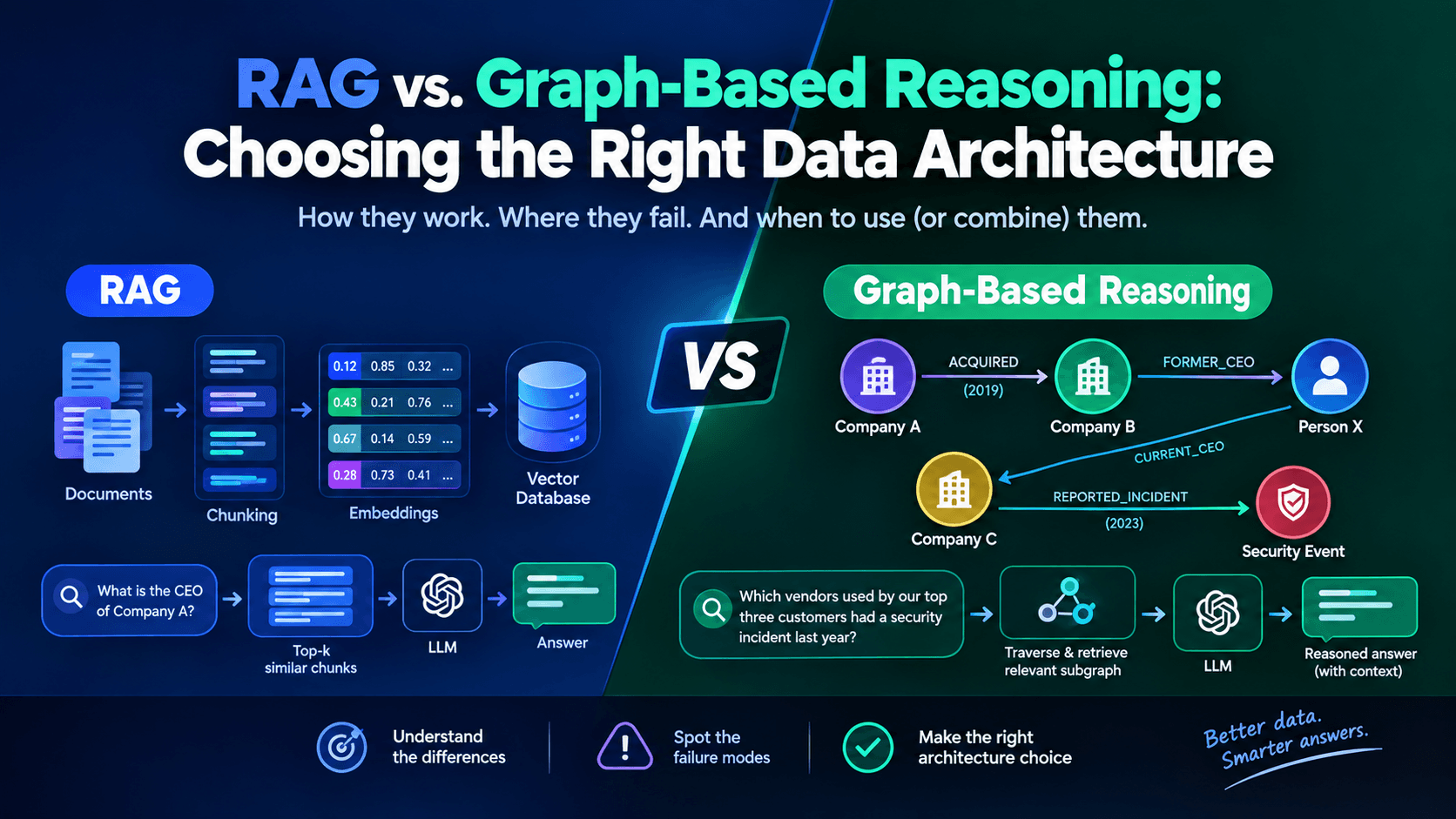
A typical RAG pipeline follows four stages: chunking, embedding, indexing, and retrieval.
1. Chunking. Source documents are split into smaller pieces — usually 200 to 1,000 tokens, sometimes with overlap — because embedding models have limited input windows and because smaller chunks tend to produce more precise similarity matches.
2. Embedding. Each chunk is passed through an embedding model, producing a dense vector that represents its semantic meaning in high-dimensional space.
3. Indexing. Vectors are stored in a vector database (Qdrant, Pinecone, Weaviate, pgvector, and similar tools) that supports approximate nearest-neighbor search.
4. Retrieval. At query time, the user's question is embedded with the same model, the vector store returns the top-k most similar chunks, and those chunks are inserted into the LLM's prompt as context.
We've covered the mechanics of building this pipeline end-to-end — including chunking strategy, embedding model selection, and index configuration — in a hands-on walkthrough: Build a RAG Pipeline with Qdrant: A Step-by-Step Guide.
Where Standard RAG Structurally Fails
The failure modes aren't implementation bugs — they follow directly from the architecture:
Chunk boundary loss. A relationship spanning two chunks (or two documents) simply isn't visible to a similarity search operating on isolated fragments. If the fact "Company A acquired Company B in 2019" is in one chunk and "Company B's former CEO now runs Company C" is in another, nothing in vector space tells the retriever these are connected.
Multi-hop questions. Questions like "which vendors used by our top three customers had a security incident last year" require traversing several relationships in sequence. Similarity search retrieves chunks that are individually relevant to the query text, not chunks that are relevant because they connect to each other.
Redundant or contradictory context. Retrieving the top-k most similar chunks says nothing about whether those chunks agree, supersede one another, or belong to different versions of the same document — the LLM has to sort that out itself, with no structural signal to lean on.
No explicit provenance graph. You can cite which chunk an answer came from, but you can't easily answer "how are these two facts related" as a structured query — only as another LLM generation, with all the hallucination risk that implies.
Standard RAG isn't wrong here — it's simply solving a narrower problem: "find text similar to this query," not "reason across a network of connected facts."
What Graph-Based Reasoning Actually Is
A knowledge graph represents information as nodes (entities — people, companies, products, events) connected by edges (relationships — "acquired," "employs," "depends on," "reports to"). Instead of retrieving similar text, a graph-based system retrieves a subgraph relevant to the query and lets the LLM reason over explicit, structured connections.
(Company A) --[ACQUIRED, 2019]--> (Company B)
(Company B) --[FORMER_CEO]--> (Person X)
(Person X) --[CURRENT_CEO]--> (Company C)
(Company C) --[REPORTED_INCIDENT]--> (Security Event, 2023)
A multi-hop question can now be answered by traversing edges rather than hoping semantically similar chunks happen to co-occur. This is the pattern popularized by Microsoft Research's GraphRAG approach, which builds a knowledge graph from source documents, detects communities of related entities, and generates hierarchical summaries so queries can be answered at different levels of granularity — from a specific fact to a broad thematic overview. Microsoft's own writeup of the method and its motivations is a useful primer on the approach: GraphRAG: Unlocking LLM discovery on narrative private data — Microsoft Research.
How a Graph Pipeline Is Built
Entity and relationship extraction. An LLM (or a dedicated NLP pipeline) reads source documents and extracts entities and the relationships between them, producing triples of the form (subject, predicate, object).
Graph construction. Extracted triples are loaded into a graph database — Neo4j is the most widely deployed option, with native support for the Cypher query language and graph algorithms. Neo4j's official documentation covers both manual graph modeling and LLM-assisted knowledge graph construction: Neo4j Documentation.
Community detection and summarization (in the GraphRAG variant). Clusters of densely connected entities are grouped and summarized, so a query about a broad theme can be answered from a community summary instead of traversing hundreds of individual edges.
Query-time traversal. At query time, relevant entities are identified, and the graph is traversed outward along relationships — a small number of hops, typically — to assemble the subgraph that gets passed to the LLM as context.
Where Graph-Based Reasoning Structurally Fails
Graph architectures trade one set of problems for another:
Extraction accuracy is the bottleneck. The graph is only as correct as the entity and relationship extraction step. If the extraction LLM misidentifies an entity or misses a relationship, that gap silently degrades every future query that depends on it — and errors in a graph tend to compound, since downstream traversal inherits upstream mistakes.
Construction and maintenance cost. Building the graph requires an upfront extraction pass over the entire corpus, and it needs to be re-run or incrementally updated as source data changes. This is meaningfully more operational overhead than re-embedding a changed document.
Latency for large traversals. Multi-hop graph queries can be fast for a few hops but grow expensive as the traversal depth or fan-out increases, especially without careful indexing and query design.
Overkill for simple lookup. If a question can be answered from a single relevant passage, building and traversing a graph to answer it is unnecessary complexity — you're paying the extraction and infrastructure cost for a problem vector search already solves well.
Side-by-Side Architectural Comparison
Dimension
Standard RAG (Vector Chunking)
Graph-Based Reasoning
Retrieval unit
Text chunk
Entity + relationship (subgraph)
Best suited for
Single-hop factual lookup
Multi-hop, relationship-heavy questions
Setup complexity
Low — embed and index
High — extraction, schema, graph build
Update cost
Re-embed changed documents
Re-extract and update graph edges
Explainability
Cites source chunk
Cites explicit relationship path
Handles contradictions well
No — LLM must infer from raw text
Better — relationships can be typed/versioned
Query latency (typical)
Low, consistent
Variable — depends on traversal depth
Infrastructure
Vector database only
Graph database (+ often a vector index too)
When Standard RAG Is the Right Choice
Documentation and support search, where the answer typically lives in one document or one section.
FAQ and knowledge-base assistants, where questions map cleanly to individual passages.
High document volume with low relationship density — large collections of mostly independent articles, reports, or transcripts.
Tight latency and cost budgets, since vector search scales predictably and doesn't require an extraction pipeline.
If your evaluation set of real user questions can mostly be answered by reading one paragraph, standard RAG is not just adequate — it's the more maintainable choice, and adding a graph would be solving a problem you don't have.
When Graph-Based Reasoning Is the Right Choice
Investigative and compliance use cases — fraud detection, due diligence, regulatory audits — where the answer depends on how entities connect, not just what any single document says.
Enterprise knowledge spanning many systems, where the same entity (a customer, a product, a vendor) appears fragmented across CRM notes, contracts, tickets, and emails, and the value is in unifying them.
Multi-hop analytical questions that require chaining several facts together — org charts, dependency graphs, supply chain analysis, incident root-causing.
Auditability requirements, where you need to show why an answer is correct as an explicit chain of relationships, not just cite a source paragraph.
The Practical Answer: Hybrid Retrieval
In production systems, this is rarely an either/or decision. The most common pattern in mature GraphRAG deployments uses vector search for initial entity or document identification, then traverses the graph outward from that starting point to gather connected context — combining the speed of vector similarity with the relational precision of a graph.
Frameworks like LangChain document this hybrid pattern directly, including how to combine a vector retriever with a graph-backed retriever in the same chain: Build a Retrieval Augmented Generation (RAG) App — LangChain Documentation. This hybrid approach also maps naturally onto Microsoft's GraphRAG distinction between "local search" (answering a specific, narrow question from nearby graph context) and "global search" (answering a broad, thematic question from community-level summaries) — you can route a query to the cheaper vector-only path or the graph-traversal path depending on its shape.
A Decision Framework
Before committing to either architecture, work through these questions against your actual query patterns — ideally using a sample of real user questions, not hypothetical ones:
Do answers typically require connecting facts from more than one source? If yes, lean graph. If no, standard RAG is likely sufficient.
How often does the underlying data change? Frequent updates favor RAG's simpler re-indexing model unless you've invested in incremental graph update tooling.
Does the use case require an explainable reasoning path, not just a cited source? Regulated industries and investigative tools should weight this heavily toward graph-based retrieval.
What's the acceptable latency ceiling? Deep multi-hop traversals are harder to keep fast and predictable than a single vector search call.
What's the team's tolerance for extraction pipeline maintenance? Graph construction quality depends on an ongoing entity-extraction process that needs monitoring and correction, not a one-time setup.
Common Pitfalls
Building a knowledge graph before validating that multi-hop questions are actually common in your usage data. Instrument and review real queries first; don't assume relationship complexity that isn't there.
Treating the extraction LLM's output as ground truth. Add validation, human review of high-stakes edges, or confidence scoring — an unverified extraction pipeline can quietly poison the graph.
Ignoring hybrid options. Teams often frame this as a full migration when a targeted graph layer added on top of an existing vector pipeline solves the multi-hop gap without discarding what already works.
Under-provisioning the graph database for traversal depth. Query performance on graphs depends heavily on indexing strategy and schema design — this needs the same engineering attention as vector index tuning, not less.
Conclusion
Standard RAG and graph-based reasoning aren't competing philosophies — they're solutions to different retrieval problems. RAG retrieves the most semantically similar text; graphs retrieve the most relevantly connected facts. Most real systems don't need to choose one architecture forever: they need to correctly diagnose which kind of question their users are actually asking, and route — or combine — accordingly. Start by measuring how often your real queries require multi-hop reasoning before building the more expensive architecture to answer questions your users may not actually be asking.
Frequently Asked Questions
Can I add graph capabilities to an existing RAG pipeline without rebuilding it?
Yes. The most common pattern layers a graph on top of an existing vector index — using vector search to find starting entities, then traversing the graph for connected context — rather than replacing the vector pipeline outright.
Does graph-based reasoning eliminate hallucination?
No. It reduces one specific cause of hallucination — missing relational context — but the extraction step that builds the graph can itself introduce errors, and the LLM can still misinterpret retrieved relationships. Neither architecture is a substitute for output validation in high-stakes use cases.
Is a graph database always required for graph-based reasoning?
Not strictly. Small relationship sets can be modeled in a relational database, but purpose-built graph databases like Neo4j provide traversal-optimized query languages and indexing that make multi-hop queries dramatically more practical at scale.
If you're evaluating this decision for a system you're actively building, our step-by-step guide to building a RAG pipeline with Qdrant is a good starting point for the vector-retrieval half of a hybrid architecture.
3Demystifying the Rust Borrow Checker: Fix Lifetime Errors Fast