A camera with worse specs than your phone just became a pre-order hit
An 8-megapixel sensor. A 2.8-inch screen. Digital, not optical, zoom. On paper, the Lola x Miffy digital camera loses to a five-year-old smartphone on every measurable spec. It's selling anyway — and the reason has almost nothing to do with photography.
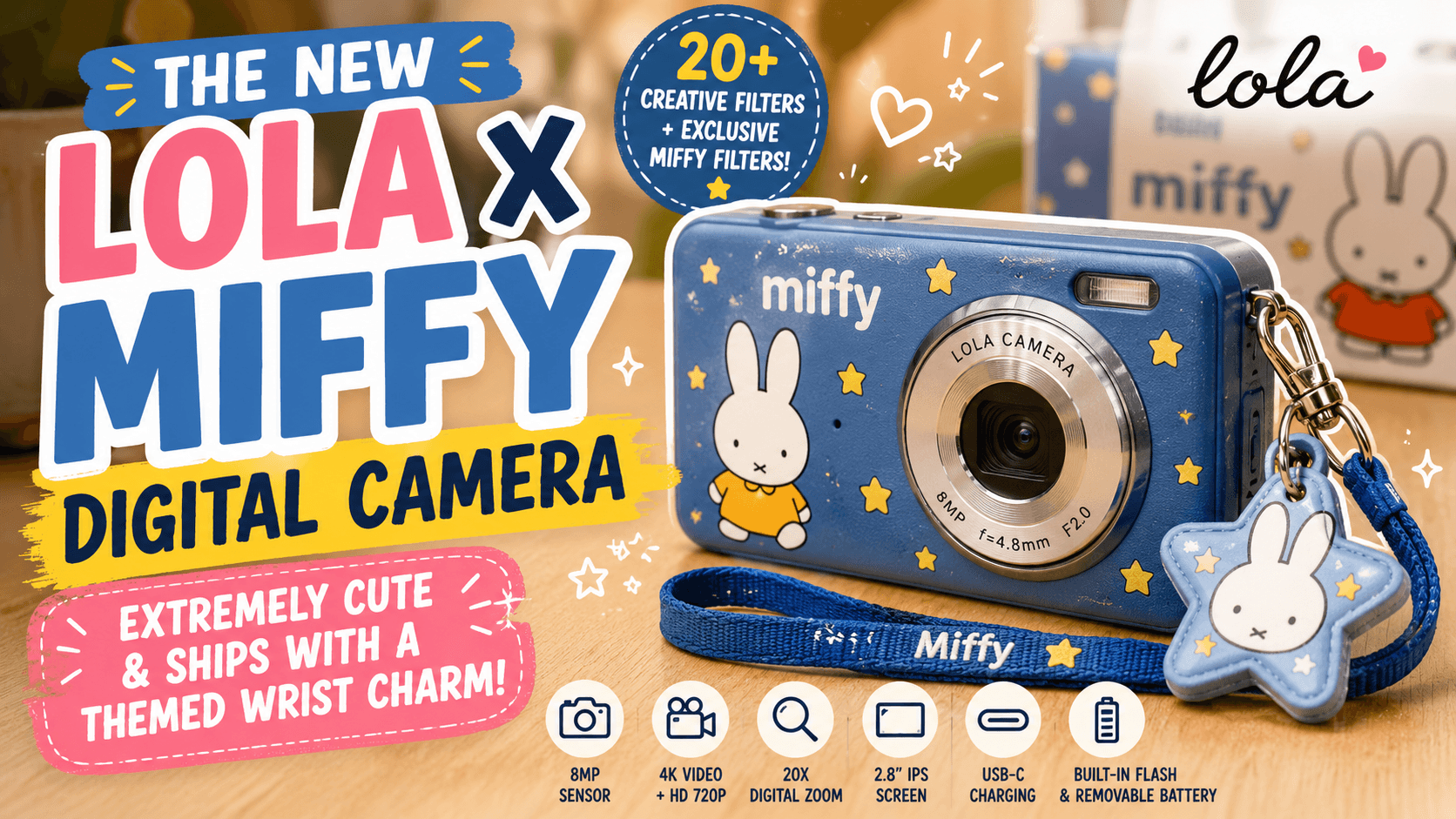
Lola, the brand that markets itself as the maker of the world's cutest digital camera, has paired with the Dutch cartoon rabbit Miffy for its latest release. The camera itself is a familiar Lola compact wrapped in a new shell — cartoon-blue, dotted with small stars, and stamped with Miffy's minimalist face. What's actually new is what's attached to it: a Miffy-themed wrist charm that doubles as a camera strap, packaged with a matching pouch.
That charm isn't a freebie. It's the product.
What actually shipped
Strip away the branding and the internals are unchanged from earlier Lola models. The camera runs an 8MP CMOS sensor with 20x digital zoom, a 2.8-inch IPS display, USB-C charging, a removable battery, and a built-in flash. Video tops out at native 720p, with interpolated 4K available in software.
Where the Miffy edition differentiates is filters and accessories:
- 20 standard creative filters, carried over from the core Lola lineup
- Five exclusive Miffy-themed filters — more than the three that shipped with Lola's earlier Betty Boop collaboration
- A Miffy-branded wrist charm that clips to the camera as a strap
- A matching carrying pouch
| Spec | Lola x Miffy |
|---|---|
| Sensor | 8MP CMOS |
| Zoom | 20x digital |
| Screen | 2.8" IPS |
| Video | 720p native, interpolated 4K |
| Charging | USB-C |
| Battery | Removable |
| Filters | 20 standard + 5 Miffy-exclusive |
| Price | $109 / £79 / AU$159 |
| Availability | Pre-order now (Urban Outfitters UK); wider launch July 31 |
"The world's cutest digital camera" — Lola's own description of its product line
Why now?
This isn't Lola's first character tie-in, and that's the point. The Betty Boop edition tested whether nostalgia licensing could move units on a device with unremarkable internals. It worked well enough that Lola is repeating the formula with a bigger-name partner and more exclusive content — five filters instead of three — while keeping the hardware itself essentially frozen.
The hardware isn't the upgrade cycle here. The IP partner is.That's a meaningful shift for a hardware category that spent the last two years selling itself on low-fi photography and Y2K aesthetics. Once that pitch is established with a core audience, the fastest way to expand it isn't a better sensor — it's a more recognizable face on the shell.
Why it matters
Digicams like this one aren't competing with smartphone cameras on image quality, and they never were. They're competing on what the object signals — a deliberate downgrade from computational photography, sold as a lifestyle accessory rather than a tool. Once a product's value is mostly aesthetic and social, licensing becomes a cheaper, faster growth lever than R&D.
Why This Matters: For hardware startups without the budget to iterate on sensors or optics, a recognizable character license can do the job a spec bump used to do — driving a new purchase cycle without touching the engineering.
That's a pattern worth watching beyond cameras. Instant-print devices, mini printers, and keychain gadgets aimed at the same buyer have leaned on the same playbook: ship a stable hardware platform, then treat character partnerships as the primary release cadence.
What changes
For consumers, it means the meaningful differences between successive drops of the same device will increasingly show up in software (filters) and accessories (charms, pouches, straps) rather than optics or sensors. For competitors chasing the same Gen Z and younger-millennial buyer, it lowers the bar to entry: a licensing deal is faster to execute than a hardware redesign, and it's now a proven demand driver in this category.
For licensors like Mercis B.V. — the company behind the Miffy character — it validates lifestyle-electronics as a licensing category worth pursuing beyond apparel and homeware, alongside existing character-camera crossovers already circulating in the same market.
What happens next
Lola's collaboration cadence — Betty Boop, now Miffy — suggests more character partnerships are likely rather than a one-off. The open question is whether a bigger studio-owned IP (something Disney- or Sanrio-scale) ends up on a future Lola shell, and whether that pushes the retro-digicam category further from "camera" and closer to "collectible with a lens attached."
FAQ
Is the Lola x Miffy digital camera actually a good camera? Its sensor and video specs are modest compared to a modern smartphone; it's built for a retro, lo-fi aesthetic rather than image quality.
When does it launch? It's available for pre-order now through Urban Outfitters in the UK, with a broader launch date of July 31.
How much does it cost? $109 in the US, £79 in the UK, and AU$159 in Australia.
What's included besides the camera? A Miffy-themed wrist charm that attaches as a strap, a matching pouch, and five exclusive Miffy filters on top of Lola's standard 20.
Conclusion
The Lola x Miffy digital camera is a modest hardware update wrapped around a much bigger bet: that character licensing, not sensor upgrades, is what will keep this category growing. The wrist charm isn't an accessory bundled with the camera — for a growing share of buyers, it may be the reason the camera sells at all.
Key Takeaways
- The Lola x Miffy camera reuses Lola's existing 8MP hardware platform; the new elements are five exclusive filters, a wrist charm, and a matching pouch.
- It follows Lola's earlier Betty Boop collaboration, suggesting a repeatable licensing strategy rather than a one-off.
- Pricing is $109 / £79 / AU$159, with pre-orders open via Urban Outfitters UK ahead of a July 31 wider launch.
- The release signals that character licensing is becoming a growth lever for niche hardware brands that can't compete on specs alone.
Suggested External Sources
- Lola Camera — official site, for brand positioning and standard product specs
- Lola x Miffy Digital Camera — Urban Outfitters UK, for regional pricing and pre-order availability
- Miffy — official site (miffy.com), for background on the character and Mercis BV's licensing program
- Engadget: "The new Lola x Miffy digital camera is extremely cute and ships with a themed wrist charm", for launch date and spec confirmation
- Digital Camera World: "The world's cutest collab", for comparison with the earlier Betty Boop collaboration