FastAPI vs. Next.js Server Actions: Choosing the Right Backend for AI-Driven Web Apps
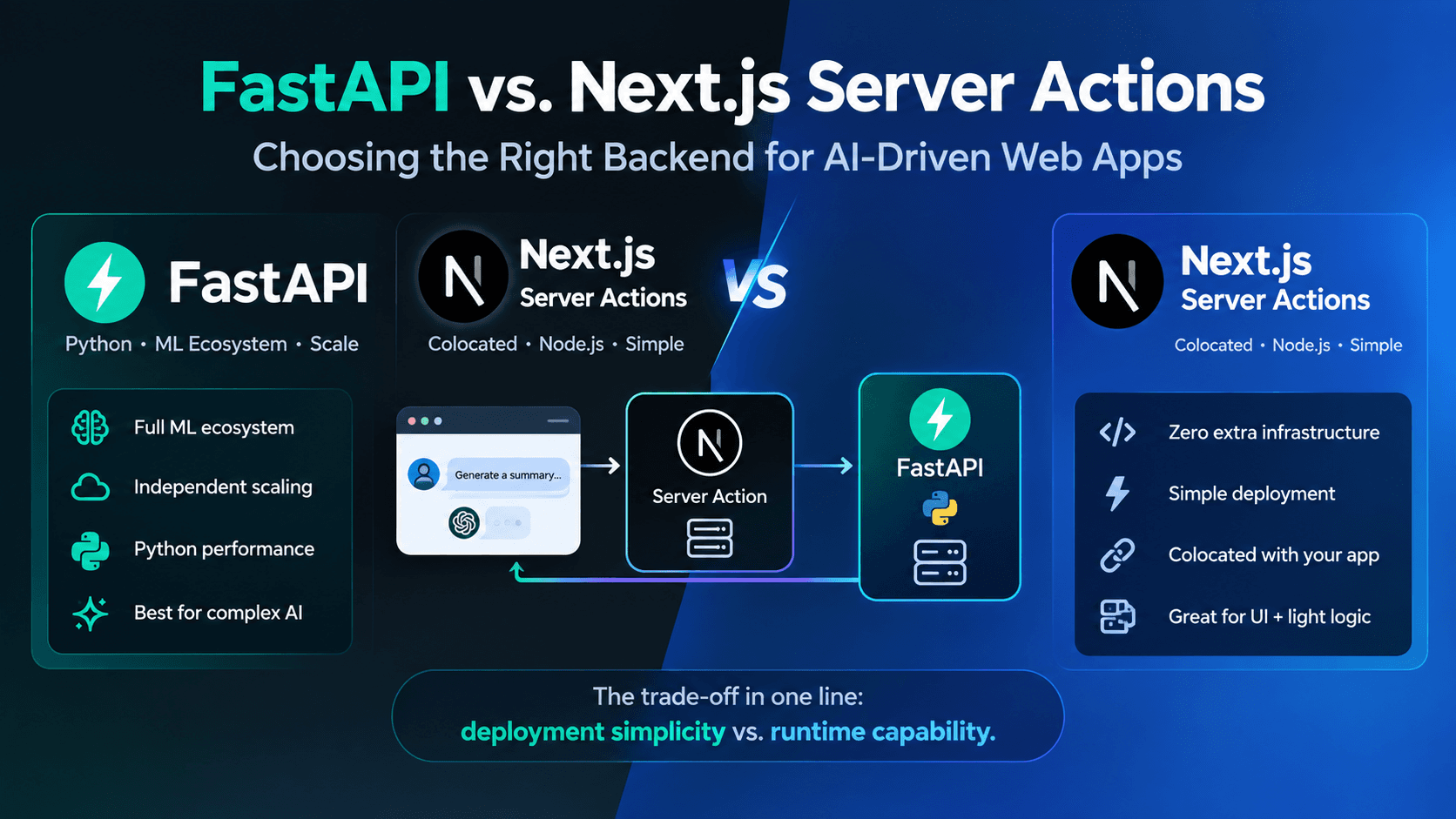
If you're building an AI feature into a Next.js app, one architectural decision shapes everything downstream: where does the model call actually run? You have two realistic options — a Server Action, which executes on the same Node.js process as your app, or a FastAPI service, a standalone Python backend running independently. Both can call an LLM. Both can return data to your React components. But they solve fundamentally different problems, and picking the wrong one either saddles you with unnecessary infrastructure or forces a serverless function to do work it was never designed for.
This guide breaks down the real trade-offs — not framework preference — with runnable code for the three situations where the choice actually matters, plus the failure modes each option runs into in production.
What Each One Actually Is
A Server Action is a function marked 'use server' that Next.js turns into a secure RPC endpoint automatically. There's no route to define, no separate deployment, and the TypeScript types flow from server to client without a serialization boundary. It runs inside the same Node.js runtime as the rest of your app — meaning it inherits the same execution limits, the same memory ceiling, and the same lack of access to Python's ML tooling.
FastAPI is a full ASGI web framework — a separate service you deploy, scale, and monitor on its own. It buys you the entire Python ecosystem (torch, transformers, diffusers, LangChain, scikit-learn), native async streaming, and no artificial time limit on how long a request can run. The cost is operational: you're now running and maintaining two services instead of one.
FastAPI vs. Next.js Server Actions: Head-to-Head
Dimension
Next.js Server Actions
FastAPI
Runtime
Node.js, same process as your app
Independent Python process
Deployment
Zero extra infra — ships with your Next.js app
Separate service to host, deploy, and monitor
Language ecosystem
JS/TS only
Full Python ecosystem (torch, transformers, LangChain, diffusers)
Streaming a model response
Not directly — needs a Route Handler alongside it
Native via StreamingResponse
Execution time limits
Bound by your hosting platform's serverless function limits (e.g. Vercel: 10s–800s)
No inherent limit — long-running processes are normal
Background/queued jobs
Not supported natively
First-class via Celery, Arq, or BackgroundTasks
GPU/self-hosted model inference
Not practical
Purpose-built for this
End-to-end type safety
Yes — shared TypeScript types, no serialization boundary
No — separate schemas (Pydantic ↔ TS), requires manual or generated typing
Independent scaling from the web app
No — scales with your Next.js deployment
Yes — scale the inference service separately
Cold start behavior
Fast, tied to your Next.js deployment's cold starts
Depends on hosting — can be slower if the model loads into memory on boot
Best for
Short, simple AI calls to hosted model APIs
Streaming control, custom pipelines, heavy or long-running inference
The underlying pattern: Server Actions optimize for developer velocity and simplicity on requests that resolve quickly. FastAPI optimizes for runtime capability — anything that needs Python's ML ecosystem, fine-grained streaming control, or execution time a serverless function can't guarantee. The three scenarios below show exactly where that line falls in practice.
Streaming a Chat Response
Streaming is the defining UX pattern of AI products — nobody wants to stare at a blank screen for eight seconds waiting for a full completion. But "streaming" means something different depending on which backend is producing it.
If you're calling a hosted model API (OpenAI, Anthropic, Google) with no custom processing in between, a Route Handler combined with the Vercel AI SDK is the shortest path to production. Note that a Server Action itself can't stream a ReadableStream back to a Client Component the way a Route Handler can — this is why the streaming endpoint lives in route.ts, not in an action file:
// app/api/chat/route.ts
import { streamText } from 'ai';
import { openai } from '@ai-sdk/openai';

export async function POST(req: Request) {
  const { messages } = await req.json();

  const result = streamText({
    model: openai('gpt-4o-mini'),
    messages,
  });

  return result.toDataStreamResponse();
}
This gives you token-by-token rendering, automatic reconnection handling, and message state management out of the box — with zero extra infrastructure beyond your existing Next.js deployment.
If you're proxying a self-hosted or fine-tuned model, or you need to run custom logic on each token (moderation filtering, redaction, injecting retrieved context mid-stream), FastAPI's StreamingResponse gives you a direct async generator over the token pipeline:
# main.py
from fastapi import FastAPI
from fastapi.responses import StreamingResponse
from openai import AsyncOpenAI

app = FastAPI()
client = AsyncOpenAI()

async def token_stream(prompt: str):
    stream = await client.chat.completions.create(
        model="gpt-4o-mini",
        messages=[{"role": "user", "content": prompt}],
        stream=True,
    )
    async for chunk in stream:
        delta = chunk.choices[0].delta.content
        if delta:
            # custom logic can run here per-token: filtering, logging, redaction
            yield delta

@app.post("/stream")
async def stream_chat(payload: dict):
    return StreamingResponse(
        token_stream(payload["prompt"]),
        media_type="text/event-stream",
    )
// Next.js client — consuming the FastAPI stream
async function askFastAPI(prompt: string, onToken: (t: string) => void) {
  const res = await fetch('https://your-fastapi.app/stream', {
    method: 'POST',
    body: JSON.stringify({ prompt }),
  });
  const reader = res.body!.getReader();
  const decoder = new TextDecoder();
  while (true) {
    const { done, value } = await reader.read();
    if (done) break;
    onToken(decoder.decode(value));
  }
}
Rule of thumb: hosted model with no custom logic → Route Handler + AI SDK. Self-hosted model, custom token pipeline, or per-token processing → FastAPI.
GPU-Bound or Long-Running Inference
This is the scenario where Server Actions are structurally disqualified, not just a worse fit. Serverless functions on platforms like Vercel have hard execution limits (10 seconds on the Hobby tier, up to 800 seconds on Enterprise), and Node.js has no production-grade ecosystem for running diffusion models, fine-tuning jobs, or batch embedding pipelines. A GPU-bound task that takes two minutes will simply time out inside a Server Action.
The correct architecture is FastAPI paired with a task queue — the request kicks off a job and returns immediately, while the actual inference runs asynchronously on a worker:
The client then polls checkGenerationStatus on an interval, or you upgrade to a WebSocket/SSE channel for push updates once the job completes. Either way, no request thread — Node.js or Python — sits blocked waiting on a GPU for two minutes. This same pattern extends to any FastAPI background task workload: model fine-tuning, batch document embedding, video transcoding, or large PDF processing.
Simple, Short-Lived AI Mutations
Not every AI feature needs the machinery above. A "summarize this note," "generate a title from this draft," or "classify this support ticket" call is a single request/response round trip that resolves in a second or two. Standing up a FastAPI service for this is real operational overhead — a second deployment target, a second set of logs, a second thing that can go down — for a task a Server Action handles natively:
// app/actions.ts
'use server';
import { generateText } from 'ai';
import { openai } from '@ai-sdk/openai';

export async function summarizeNote(noteText: string) {
  const { text } = await generateText({
    model: openai('gpt-4o-mini'),
    prompt: `Summarize this note in one sentence:\n\n${noteText}`,
  });
  return text;
}
// app/notes/note-form.tsx
'use client';
import { summarizeNote } from './actions';
import { useState } from 'react';

export function NoteForm() {
  const [summary, setSummary] = useState('');

  return (
    <form action={async (formData) => {
      const text = formData.get('note') as string;
      setSummary(await summarizeNote(text));
    }}>
      <textarea name="note" />
      <button type="submit">Summarize</button>
      <p>{summary}</p>
    </form>
  );
}
There's no API route to define, no CORS configuration, no manual request/response typing to keep in sync — the function signature is the contract between client and server, checked by TypeScript at compile time. It also progressively enhances: this form submits correctly even before client-side JavaScript hydrates. For the large majority of "sprinkle AI into an existing feature" work — classification, short generation, extraction from a form field — this is the correct default, not FastAPI.
Error Handling and Type Safety Across the Boundary
One trade-off the comparison table doesn't fully capture: what happens when things go wrong, and how much manual work you do to keep types in sync.
With Server Actions, an unhandled error on the server surfaces to the client as a generic error unless you explicitly catch and shape it — but because there's no network boundary, TypeScript catches shape mismatches at compile time before you ever ship:
With FastAPI, you're crossing a real network boundary, so Pydantic models define the contract on the Python side, and you either hand-write matching TypeScript types on the Next.js side or generate them from the OpenAPI schema FastAPI produces automatically:
If your API response shapes get complex or inconsistently cased coming back from Python, typing them cleanly on the Next.js side is worth doing properly — see Advanced TypeScript Mapping for patterns that handle this without resorting to any.
Heavy Python ML libraries (torch, transformers, LangChain agents)
FastAPI
Need independent scaling from the web app
FastAPI
Want zero extra infrastructure to manage
Server Action
The Hybrid Pattern Most Production Apps Actually Use
In practice, mature AI products rarely pick one exclusively. Server Actions handle lightweight, auth-gated mutations and simple generation calls close to the UI. FastAPI runs as a dedicated inference layer behind it — handling streaming control, custom models, and background jobs. Next.js becomes the orchestration and presentation layer; FastAPI becomes the model-serving layer. If that data layer also needs to persist structured AI output — generated metadata, embeddings, classification results — pairing this with JSONB columns for flexible, queryable storage is worth reading up on: see our JSONB Deep Dive for containment queries and indexing strategy that holds up at scale.
Frequently Asked Questions
Can Server Actions call Python code directly?
No. Server Actions run in the Node.js runtime. To use Python — for ML libraries, custom inference, or GPU work — you call out to a separate service like FastAPI over HTTP.
Is FastAPI faster than Server Actions?
Neither is inherently faster. In almost every real case, the bottleneck is the model inference call itself, not the framework processing the request. Choose based on capability — Python ecosystem access, streaming control, background job support — not raw request overhead.
Do I need FastAPI if I'm only calling the OpenAI or Anthropic API?
Usually not. If you're calling a hosted model API and doing no custom Python processing, Server Actions and Route Handlers can handle the entire flow with less infrastructure to maintain.
Can I migrate from Server Actions to FastAPI later without a full rewrite?
Yes — this is common. Because a Server Action is just a function, you can swap its internals from a direct model call to a fetch against a FastAPI endpoint without changing anything on the client side.